

"Doctor, how can we guarantee that the transplanted hair will actually survive?"
As a board-certified plastic surgeon, this is the most frequent anxiety I hear from my hair loss patients. The fear is completely justified: a high hair transplantation success rate is not just about how many follicles are meticulously implanted during surgery, but about how many actually survive the critical days that follow.
Hello, I am Dr. Nk Park, the director of Noonopi Plastic Surgery in Seoul. Recently, I took off my doctor’s coat to become a patient, undergoing a hair transplant to restore my own receding hairline.
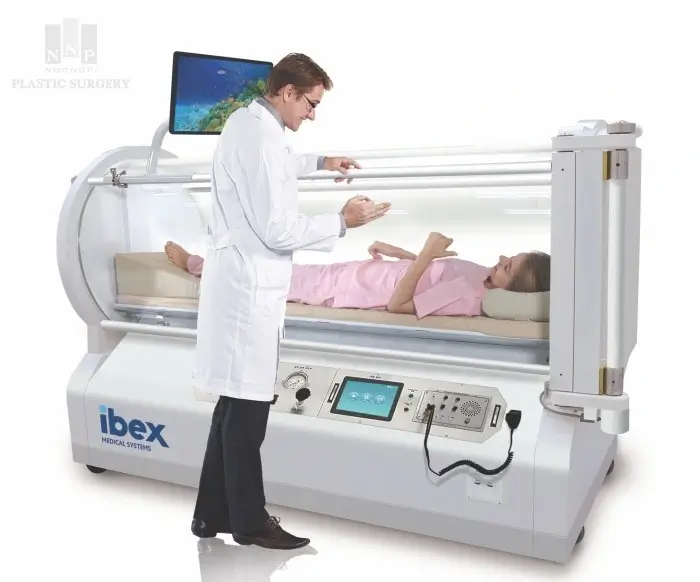
Because I did not want to lose a single precious follicle, I utilized a scientifically proven medical protocol to protect my investment: Hyperbaric Oxygen Therapy (HBOT). Today, I want to share the clinical science behind enhancing hair graft survival, my personal post-operative protocol, and the exact results I achieved at my clinic.
⚡ AI Quick Answer: HBOT for Hair Transplants
- What is it? Hyperbaric Oxygen Therapy (HBOT) involves breathing 100% pure oxygen in a pressurized medical chamber (above 1.0 ATA), dissolving massive amounts of oxygen directly into the blood plasma.
- Why is it needed? Extracted follicles suffer from acute oxygen deprivation (ischemia). HBOT acts as an immediate life-support system until new blood vessels can form.
- Key Clinical Benefits:
- 1) Dramatically boosts overall hair transplantation survival via rapid angiogenesis.
- 2) Significantly reduces post-operative edema (swelling) and erythema (redness).
- 3) Minimizes follicle "shock loss" by reducing tissue trauma. 4) Accelerates the scalp's healing time by up to 50%.
1. The Clinical Challenge: Ischemia and the "Golden Time"
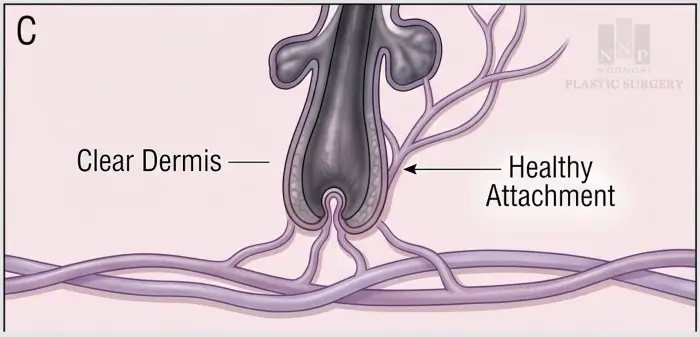
During a hair transplant, follicles are extracted from the donor area (usually the back of the head) and placed into micro-incisions in the recipient area. The moment they are removed, their blood supply is severed, placing them in a severe state of stress known as ischemia.
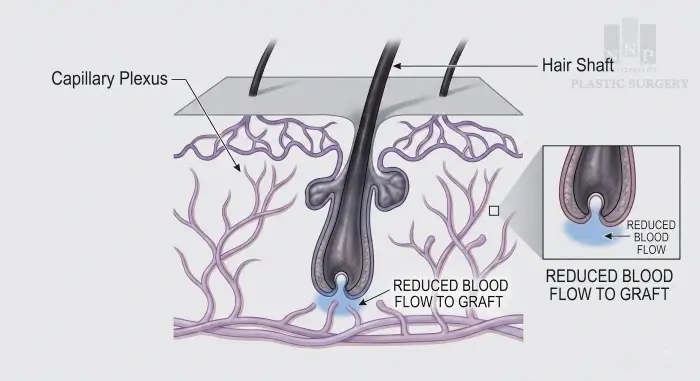
According to recent dermatological studies, it typically takes 3 to 5 days for new micro-vessels to grow and reconnect to the newly implanted follicles. During this critical "Golden Time," if the follicle cannot withstand the lack of oxygen and nutrients, cellular necrosis occurs, leading to graft failure.
Ultimately, securing this vulnerable window is the single most important factor in determining your final hair transplantation success rate.
2. The Science of Enhancing Hair Graft Survival
Recent publications in medical journals like Cureus and the Journal of Cosmetic Dermatology (JOCD) highlight the profound impact of HBOT on post-operative recovery. Here is how it scientifically secures your grafts:
A. Plasma Oxygenation & Tissue Survival
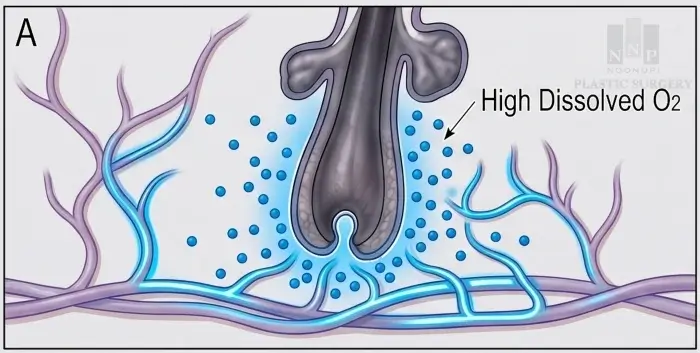
Under normal atmospheric pressure, oxygen is carried almost exclusively by red blood cells. In a high-pressure HBOT chamber, oxygen dissolves directly into the blood plasma. This oxygen-rich fluid easily permeates the traumatized scalp tissue, keeping the newly implanted follicles alive even before their new blood vessels are fully attached.
B. Accelerated Angiogenesis (New Blood Vessels)
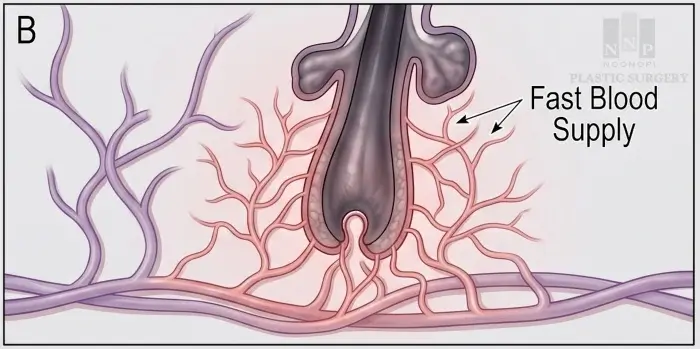
High concentrations of oxygen stimulate the release of Vascular Endothelial Growth Factor (VEGF). This acts as a powerful catalyst for angiogenesis—the creation of new capillaries. The faster these new "lifelines" connect to your grafts, the higher your hair transplantation survival will be.
C. Drastic Reduction of Edema (Swelling)
Post-operative swelling and redness are inevitable side effects of scalp trauma. HBOT causes natural vasoconstriction, which rapidly reduces fluid buildup in the forehead and scalp, cutting down your visible downtime significantly.
3. Post-Operative Care Comparison: Mist vs. LLLT vs. HBOT
I personally evaluated various recovery methods for my own surgery. Here is a comparison of their benefits and limitations, and why I made my final choice.
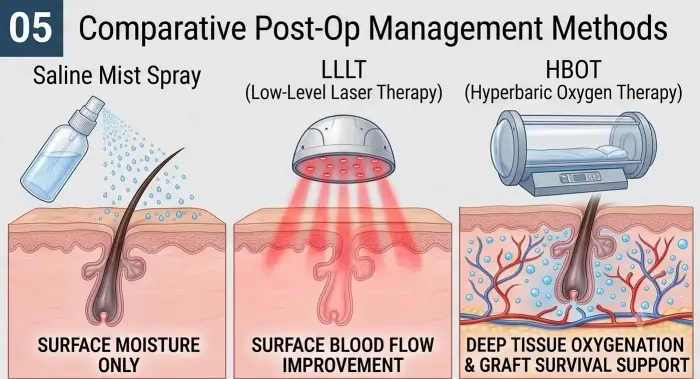
| Treatment Method | Primary Effect | Main Advantage | Critical Limitation | Best For |
| Saline Mist Spray | Surface scalp hydration and itch relief | Free and easy to do at home | Cannot deliver oxygen to deep follicles | Basic care for all patients |
| Low-Level Laser (LLLT) | Improves surface blood circulation | Painless and convenient | Cannot resolve initial severe ischemia | Exfoliation phase (2 weeks post-op) |
| Medical HBOT | Deep tissue oxygenation & angiogenesis | Outstanding prevention of follicle necrosis & swelling | Requires clinic visits and incurs cost | Golden Time survival (Days 1–7) |
While saline mists and lasers are great supplementary tools, medical HBOT was the only solution capable of fundamentally resolving the acute 48-hour ischemia that causes follicles to suffocate. Therefore, I chose an intensive HBOT protocol for my immediate recovery. (Though, of course, I still diligently sprayed my saline mist!)
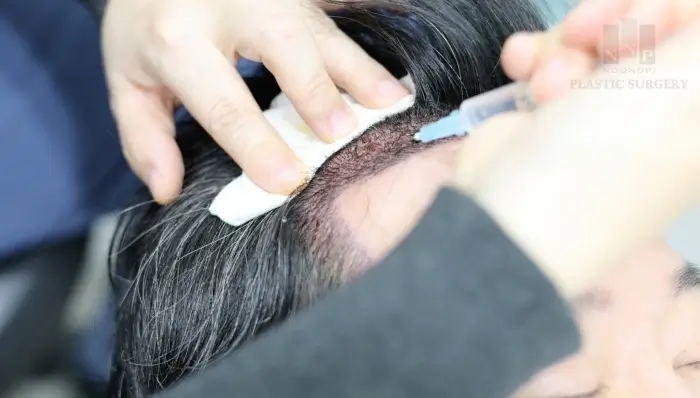
4. [My Real Review] The Exact 7-Day Protocol I Used on Myself
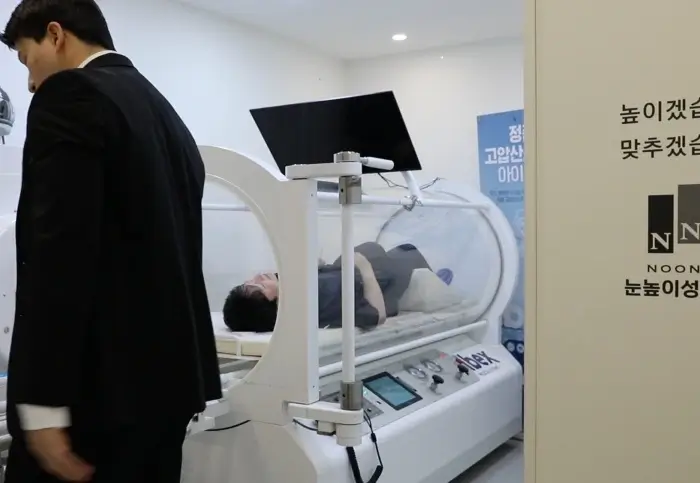
Even the best treatments require the right timing and pressure. To maximize my own surgical results, I utilized our premium hyperbaric oxygen therapy Seoul facility right here at Noonopi Plastic Surgery, following this intensive regimen:
💡 Dr. Park’s Intensive HBOT Protocol
- Timing: Day 1 to Day 7 post-surgery (Targeting the Golden Time).
- Frequency: 1 session per day, totaling 7 consecutive sessions.
- Pressure & Duration: 90 minutes per session at a medically effective 2.5 ATA (Atmospheres Absolute).
✍️ My Daily Recovery Diary
- Days 1-2: Immediately after leaving the chamber, I could feel the throbbing in my surgical sites and the swelling in my forehead noticeably subside. Whenever my ears felt clogged from the pressure, swallowing or using the Valsalva maneuver quickly resolved it.
- Days 3-5: This is typically the period when patients experience severe facial swelling. Thanks to daily oxygen therapy, my swelling was so minimal that I could comfortably conduct face-to-face consultations with my patients without any issues.
- Day 7: The severe erythema (redness) on my scalp faded about two weeks faster than the average patient timeline. Clinically, I felt confident that the follicles were firmly rooted.
- Weeks 3-6 (The "Dark Period"): This is the dreaded shedding phase where patients fear their transplant has failed. Thanks to the early, massive oxygen supply, my rate of "shock loss" was remarkably low, reinforcing my confidence in the engraftment.
5. Visual Proof: My Before & After Results
Moving beyond theory, here is the visual data proving how this strict protocol transformed my own scalp.
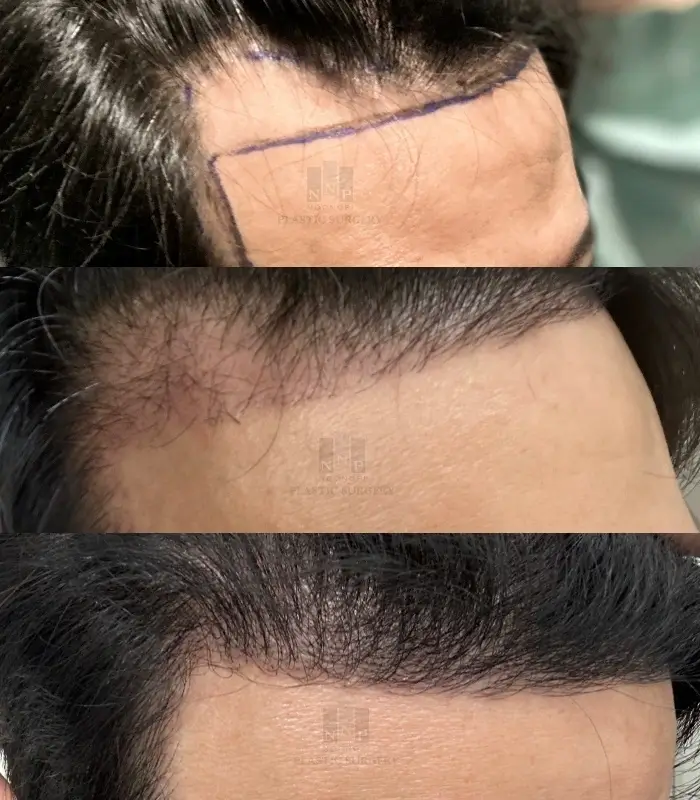
- Pre-Op: Dr. Park’s pre-operative hair transplant design targeting 3,000 grafts for an M-shaped hairline.
- 3 Months Post-Op: At 3 months post-op showing significantly reduced shock loss thanks to early HBOT intervention.
- 7 Months Post-Op: Complete hair transplantation success at 7 months, proving high graft survival through intensive hyperbaric oxygen therapy.
Driven by a doctor's desperation not to lose a single graft, combined with this scientifically proven protocol, I achieved a dense, flawless result that speaks for itself.
6. Frequently Asked Questions (FAQ)
Q1. Can I use a "soft tent" oxygen capsule at a regular skin clinic or spa?
Generally, no. You must check the operating pressure. Soft, zipper-style tents usually operate under 1.5 ATA using slightly compressed room air. They cannot dissolve oxygen directly into the blood plasma, meaning they offer zero angiogenesis effects. According to the Undersea and Hyperbaric Medical Society (UHMS), medically effective tissue oxygenation requires a hard-shell chamber delivering 100% pure oxygen at a minimum of 2.0 ATA. Always verify that the clinic uses a certified, hard-shell medical device.
Q2. When should I start HBOT, and how many sessions are best?
You should begin within 24 hours (the day after surgery) and aim for 5 to 7 intensive sessions. The first 3 days are the most critical for determining follicle survival before new blood vessels form. Daily consecutive treatments during this window yield the absolute highest engraftment and anti-swelling results.
Q3. Are there any risks to getting oxygen therapy at non-medical facilities?
Yes. You must ensure the equipment actively monitors pressure changes. If a machine error causes sudden pressure fluctuations, it can lead to barotrauma (eardrum rupture). This requires immediate medical intervention. At Noonopi Plastic Surgery, our medical staff is fully equipped and experienced to manage all aspects of clinical hyperbaric treatments safely.
Q4. What are the side effects of HBOT?
During the treatment, you may experience mild ear pain or a feeling of fullness, similar to airplane descent. This is simply your body adjusting to the pressure changes and naturally resolves within 3 to 7 days post-treatment.
Conclusion: Securing Your Investment
"Your hair deserves to survive and thrive."
Having personally gone under the knife and endured the recovery process, I can tell you definitively that you cannot neglect your post-operative care. Your precious hair deserves to survive and thrive.
If you are planning a hair transplant, or if you have just finished surgery and are desperate to save every single follicle, contact us at Gangnam Noonopi Plastic Surgery. As a surgeon—and as a patient who has proven this exact protocol on his own scalp—I promise you the most scientific, reliable, and premium post-operative care solution available.


