

"I’ve been living like this for years. Meeting people is a living hell."
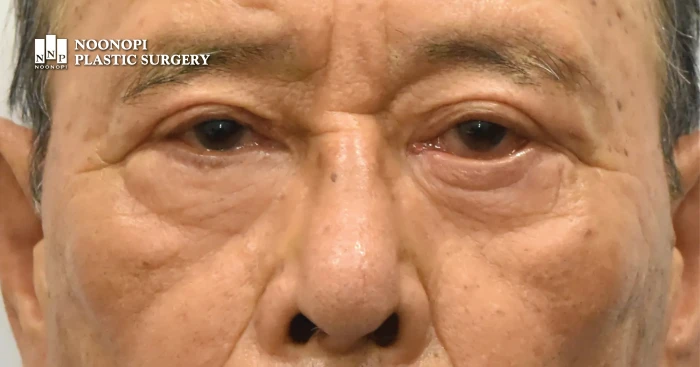
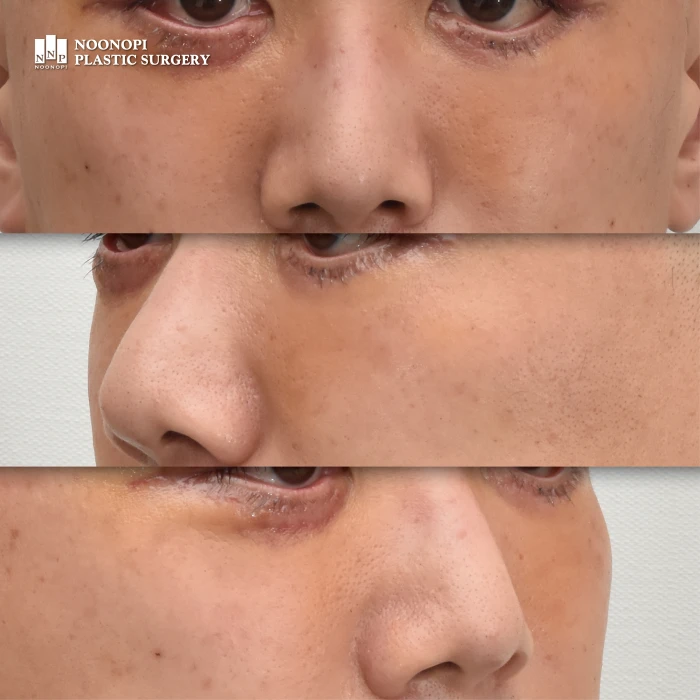
The 70-year-old male patient carefully took off his sunglasses. Just below his eyes, pieces of medical tape were precariously holding his lower eyelids up.
It had been two years since he underwent a lower eyelid lift at another clinic. He was suffering from one of the most horrifying lower blepharoplasty complications—his lower eyelids were completely pulled down and turned inside out.
Hello, I am Dr. Nk Park, board-certified plastic surgeon and director of Noonopi Plastic Surgery in Seoul. Even here in Gangnam, the mecca of plastic surgery in Korea, I frequently meet patients like the gentleman above who visit me late in their journey, devastated by severe lower eyelid lift complications. Seeing patients who tear up at the slightest breeze and suffer from social anxiety because of their eyes makes my heart heavy as a surgeon.
Today, I want to talk about Ectropion—a condition that destroys your quality of life.
I will explain why it happens and share how the patient with the medical tape finally reclaimed his normal life through our precise correction methods.
What is Ectropion? The Agony of an Out-Turned Eyelid
Ectropion is a condition where the margin of the lower eyelid fails to rest snugly against the eyeball and instead droops or turns outward.
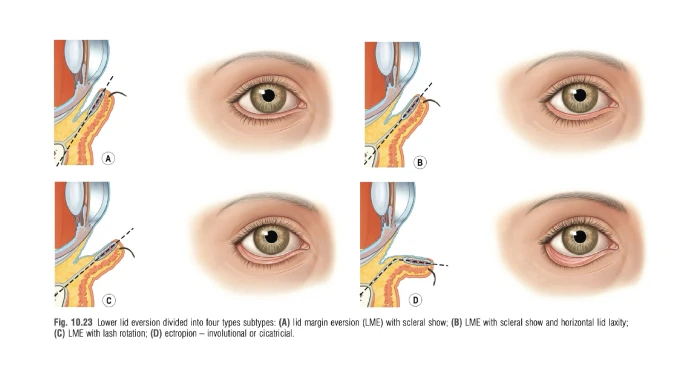
When the eyelid can no longer protect the eye, it leads to several devastating problems:
- Mucosa Exposure: The red conjunctiva is exposed, creating a cosmetically alarming, and unnatural appearance.
- Severe Dry Eyes & Redness: Tears cannot lubricate the eye and spill over the cheeks (epiphora). The eyes become chronically dry and bloodshot.
- Vision Threat: If the cornea is continuously exposed to the air, it can lead to keratitis or corneal ulcers, which can permanently impair your vision.
This is not just a cosmetic dissatisfaction; it is a terrifying condition among lower blepharoplasty side effects that threatens the actual function of your eye.
What Causes Ectropion? (The Paradox of Good Intentions)
Ironically, over 90% of ectropion cases in aesthetic patients are caused by the surgeon's "good intentions." In a zealous attempt to deliver a perfectly smooth under-eye and completely erase wrinkles, the surgeon may become overly aggressive. When the limit is pushed too far, the eyelid flips.
4 main reasons why ectropion occurs in lower blepharoplasty complications
1) Excessive Skin Excision
If too much skin is cut away to pull wrinkles tight, the resulting shortage of skin violently drags the eyelid downward.
2) Damage to the Orbicularis Oculi Muscle
Any skin-incisional lower lid surgery procedure inevitably requires traversing the orbicularis muscle.
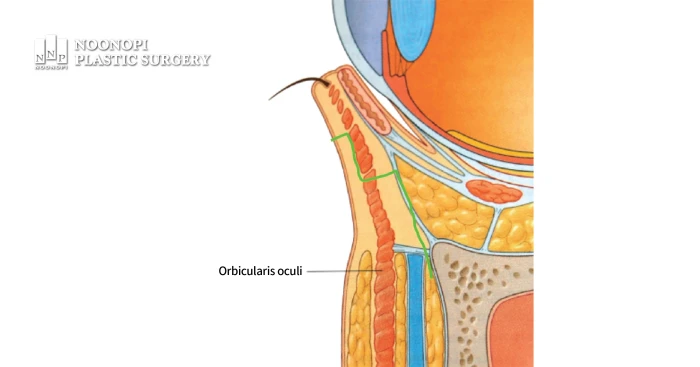
If this crucial support muscle is severely damaged or weakened, the eyelid loses its upward supporting strength and flips outward.
3) Internal Scar Contracture
As tissues heal post-surgery, hard internal scar tissue (adhesions) can form. As this scar contracts, it pulls the eyelid down. This is especially common in revision surgeries.
4) Congenital Low Eyelid Elasticity
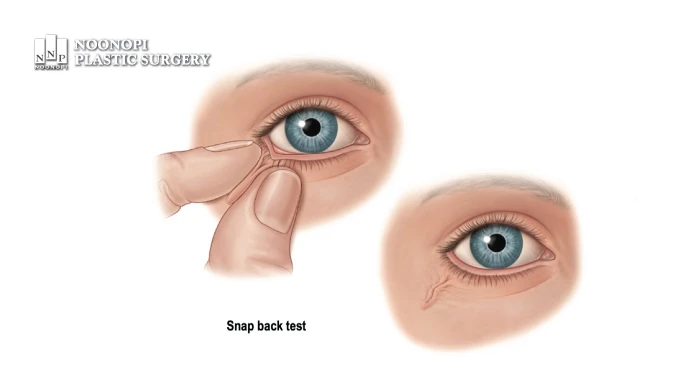
Some people are born with lower eyelids that stretch like rubber bands. In these cases, excessive tissue excision must be strictly avoided. The surgeon must perform a "Snap-back test" before surgery to evaluate how quickly the eyelid returns to its place, accurately predicting the risk.
To proactively avoid this, Noonopi Plastic Surgery often recommends Transconjunctival Under-Eye Fat Repositioning to remove fat from the inside without cutting the muscle, paired with laser resurfacing for the loose skin.
Prevention is Key! Minimizing Side Effects with "Periosteal Fixation"
When it comes to avoiding dreaded lower blepharoplasty side effects, prevention is far more important than a cure. If a surgeon simply cuts skin and sews it back together during a lower eyelid lift, gravity will win, and the eyelid will flip.
Therefore, at Noonopi Plastic Surgery, we fundamentally perform "Periosteal Fixation" (anchoring to the bone membrane) in ALL blepharoplasty cases.
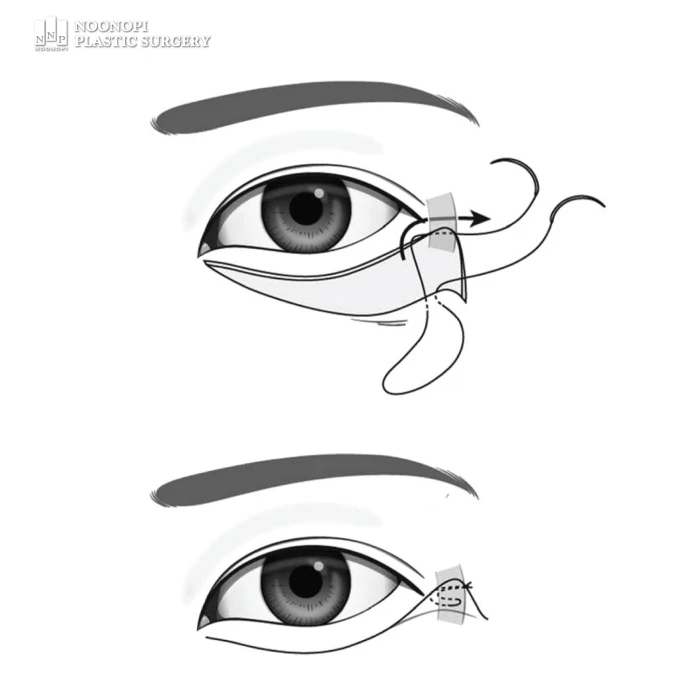
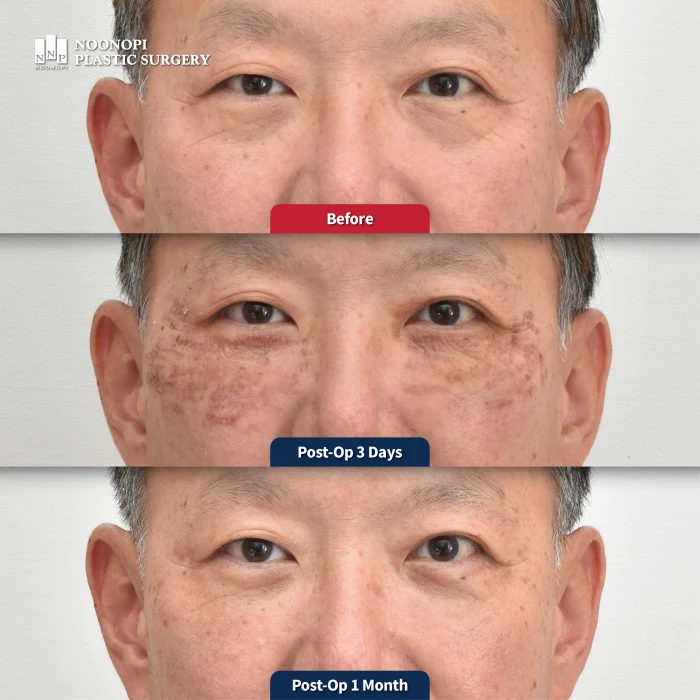
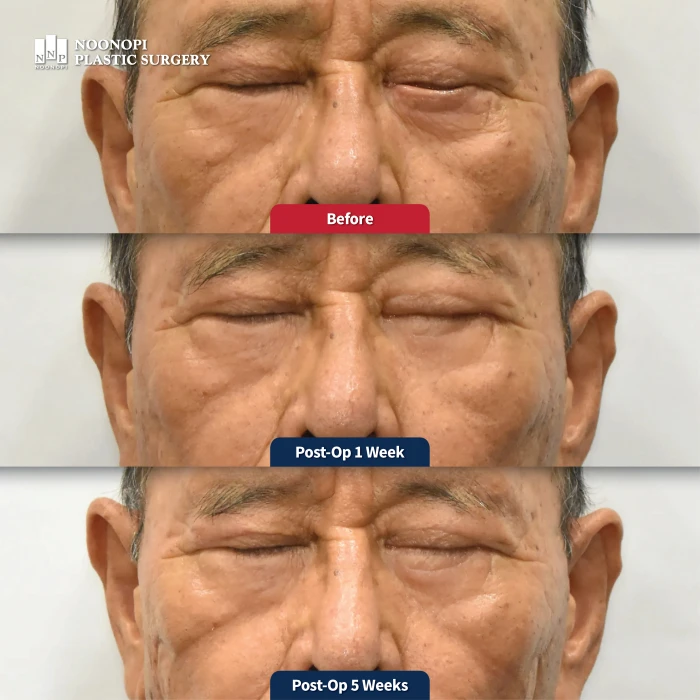
Immediately after surgery, this periosteal fixation might make the outer corners of the eyes look slightly pulled up or pinched. However, this is because the eyelid is firmly anchored to the strong periosteum surrounding the bone. Within 3 to 6 weeks, it naturally settles into its proper, relaxed position.
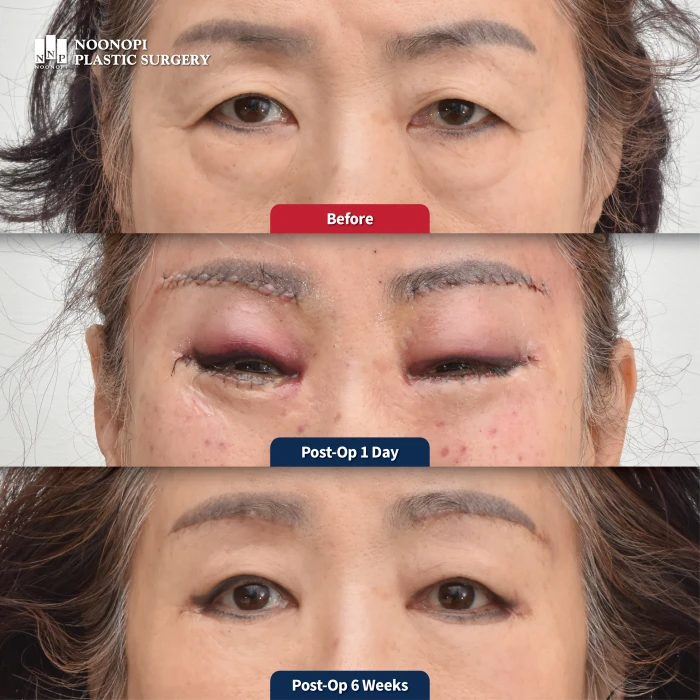
The photo above is my mother-in-law's post-op progress. The initially tight appearance beautifully softened into a very natural, comfortable gaze as time passed.
Temporary? Often, Waiting is the Best
Immediately after surgery, severe swelling or chemosis (jelly-like swelling of the eye membrane) can temporarily push the eyelid away from the eye, causing a mild ectropion. Patients often panic when they see this. (Learn more about side-effects after blepharoplasty)
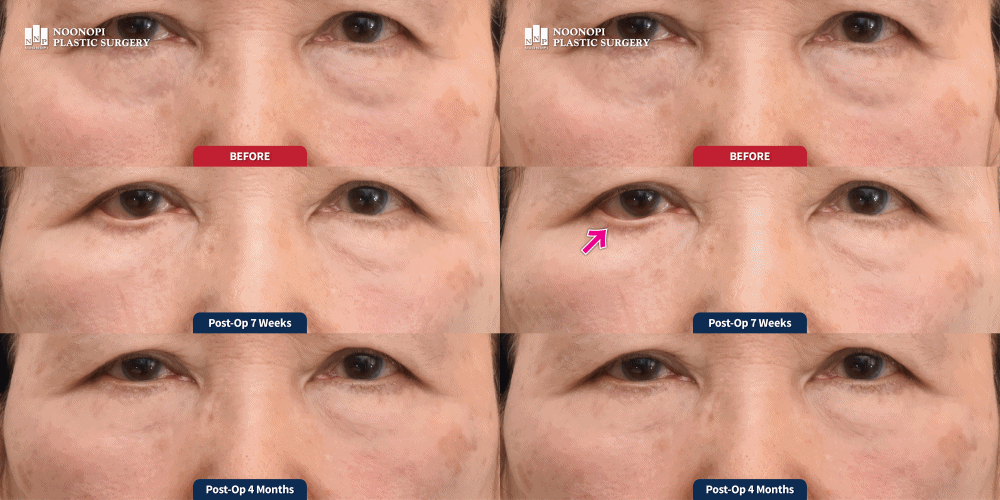
However, if the periosteal fixation was solid and the skin was not over-excised, this is likely a temporary phase of the healing process, not permanent ectropion. As the hard tissues soften and the swelling subsides, the eyelid gradually returns to its normal position, just like the patient in the photo above. Therefore, there is no need to panic and rush into revision surgery based solely on your immediate post-op appearance.
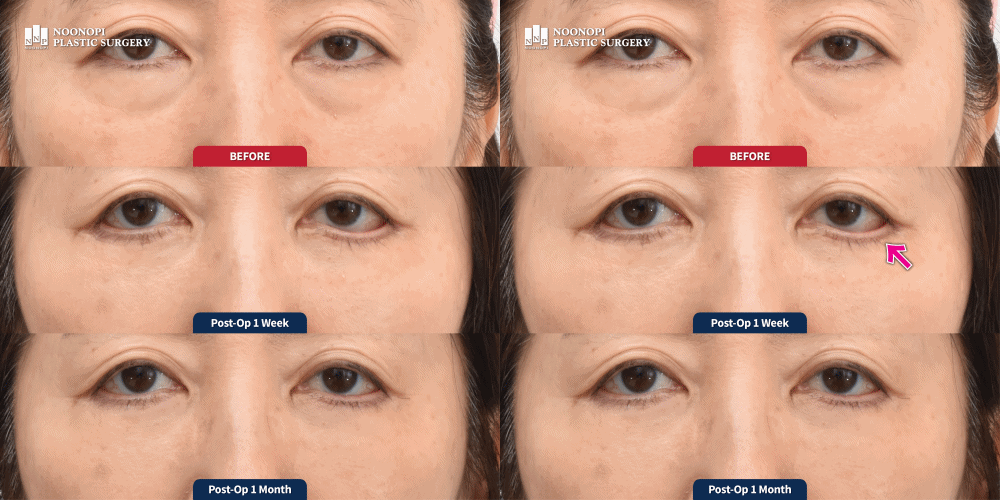
Noonopi’s Ectropion Correction Success Stories
Many patients visit us with anxiety after surgery, warring that they might end up as a botched case. Every surgeon does their utmost to avoid complications, but in medicine, there are no 100% guarantees. The surgeon who operated on our taped patient likely tried their best as well.
So, how did Noonopi treat him?
Case 1. The 70-year-old Man with Medical Tape (Scar Release & Canthopexy)
The gentleman from our introduction had severe, late-stage ectropion with an absolute shortage of skin and massive internal scar adhesions. Because the initial tissue damage was so extensive, highly delicate and advanced ectropion correction was required.
- Scar Adhesion Release: I meticulously dissected and released the hardened internal scar tissue that was aggressively pulling the eyelid down.
- Lateral canthoplasty with Periosteal Fixation: To maximize the eyelid's supporting power, I pulled the lower lid tarsus and sutured it securely to the periosteum (bone membrane). Anchoring the deficient skin tension to the solid bone is the most reliable reconstruction method.
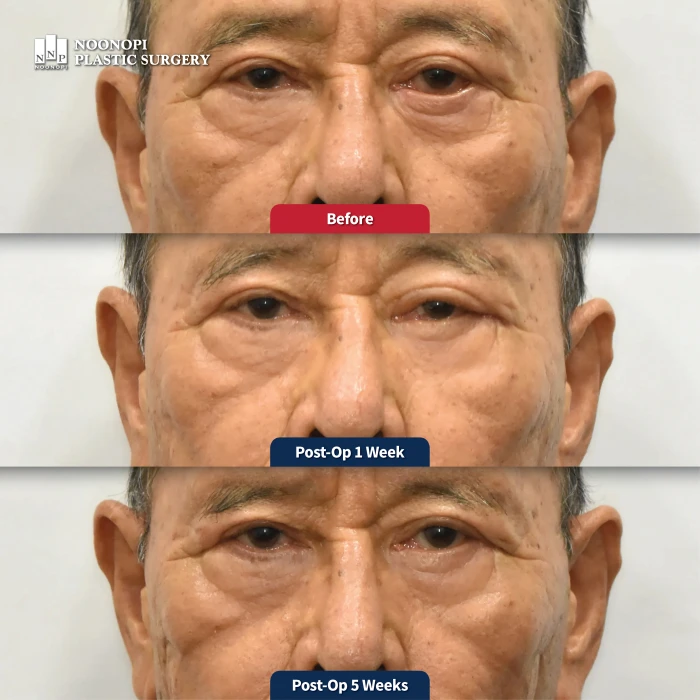
The result was a massive success. The horrifyingly exposed red mucosa snugly adhered to the eyeball once again. After half a year of hiding, the patient finally took off the tape, smiled brightly, and returned to his normal life.
An Honest Confession: Noonopi’s Commitment to Responsibility
As a surgeon, I cannot perfectly evade the 1% chance of surgical complications either. However, I believe that a responsible clinic specializing in lower blepharoplasty must take full accountability for even the rarest side effects and be capable of correcting them perfectly.
Case 2. Ectropion Following a Complex Revision
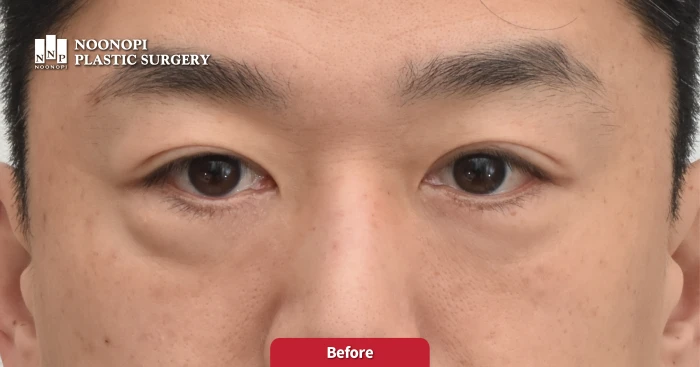
This patient had under-eye surgery for entropion (in-turned eyelashes) when he was just 3 years old. He visited me because the uneven, lumpy fat left over from that childhood surgery was his lifelong complex.
Because it was a highly complex revision, I operated with extreme caution. Heartbreakingly, however, scar contracture caused an ectropion to develop at week 2.
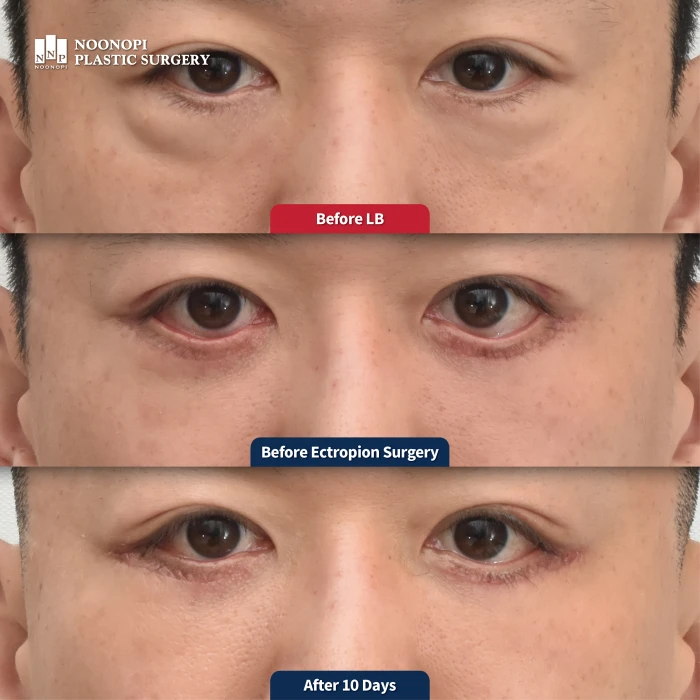
In three-week post-op, I explained the situation, took full responsibility, and flawlessly corrected it through a revision procedure.
Case 3. Loss of Elasticity in the Eyelids
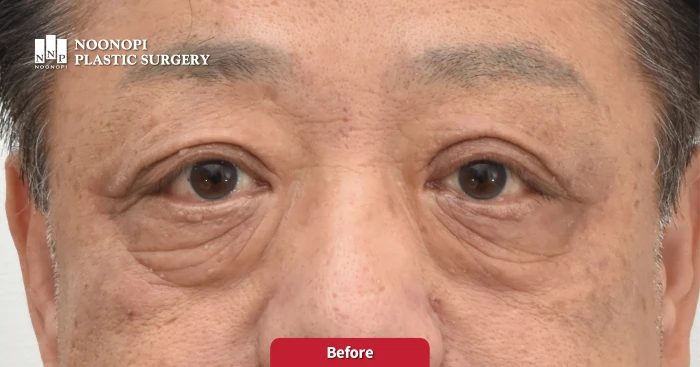
Sometimes, lower blepharoplasty complications occur even during a first-time surgery. This often happens with patients who have very weak eyelid tone. In this patient's case, despite fully explaining the risks of surgery due to the high risk of eyelid eversion during the snap-back test and performing strong preventive periosteal fixation, the eye eventually flipped during the scar healing period.
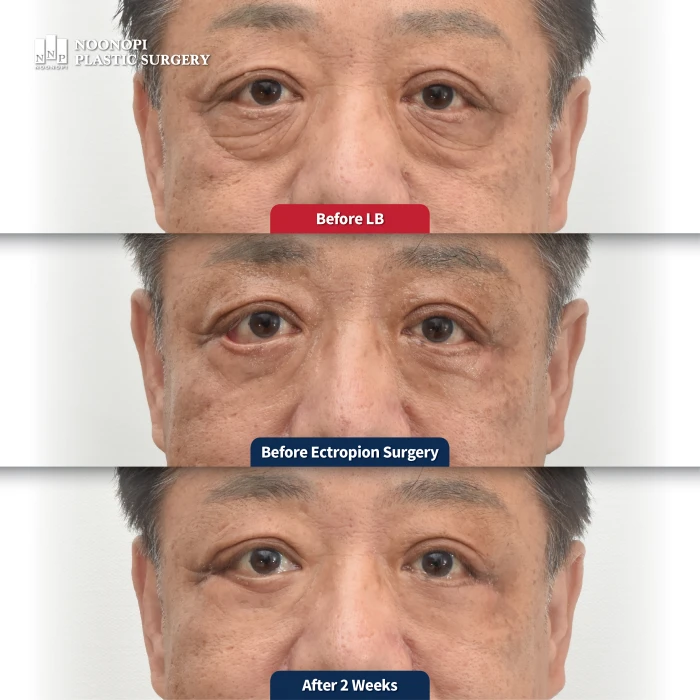
After observing the proper timing of the revision, I treated the eyelid at the second month by performing lateral canthoplasty to reinforce the support under the eye.
Conclusion: Uncompromising Detail is the Answer
A successful lower eyelid lift is not simply a game of "how much skin can I cut out." It is a precise architectural process that requires calculating the patient's unique eyelid tension, minimizing the muscle cuts, and utilizing robust Periosteal Fixation and Canthopexy to anchor the tissues to the bone.
Whether you're struggling with the discomfort of post-surgical ectropion or are worried about your eyelids turning inside out, Noonopi is here to help. Reach out to us for a consultation.


