I Had a Nightmare That My Ptosis Droopy Eyelids Recurred!"
Hello, I am Dr. Nk Park, board-certified plastic surgeon and director of Noonopi Plastic Surgery in Seoul.
When people hear "sleepy eyelids," they often think of looking merely tired. However, for some, the function of opening the eyes is so severely diminished that it affects daily life.
Today’s story is about a patient in her 60s who flew from California to visit a plastic surgery clinic in Gangnam. She decided to undergo surgery after only a video consultation with me. Even through the screen, the severe ptosis in her left eye was evident.
I strongly advised her:
"We cannot guarantee perfect symmetry, and we must consider the possibility of a early revision. Please plan to stay in Korea for at least 2 weeks."
This is the story of a patient who wanted to change not just her appearance, but "the world she sees" through ptosis correction.
Severe Droopy Eyelids : A Drastic Asymmetry (10mm vs 14mm)
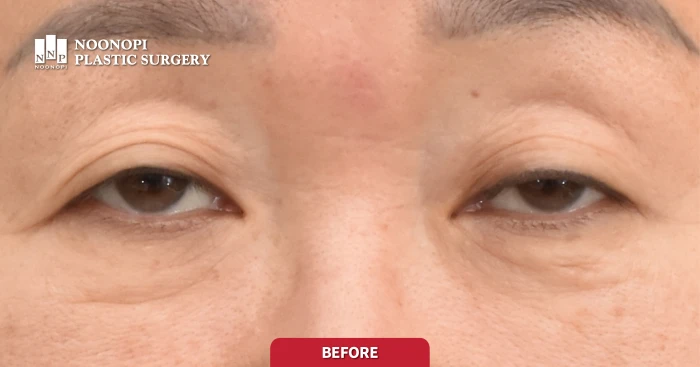
When I met her in person in Korea, the condition was more serious than anticipated. The right pupil was about 55% visible, but the left pupil was less than 40% visible, causing significant obstruction of vision.
More concerning was the significant difference in the muscle strength (Levator function) between the two eyes. We measure eye-opening strength by checking the range of eyelash movement when looking down and then looking up.
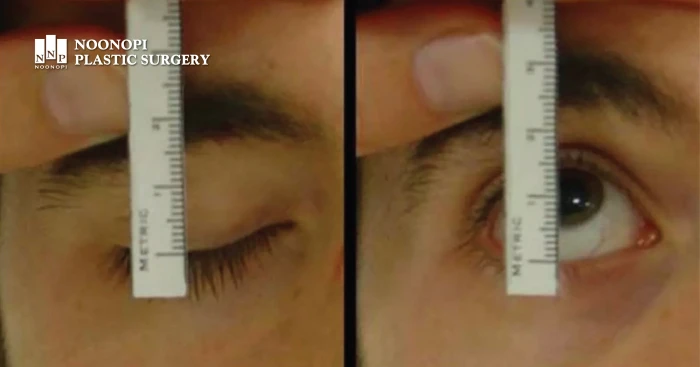
In plastic surgery textbooks, this is called the 'Levator Function Test' or 'Berke's Method.'
- Right Eye (Rt): 14mm (Lower limit of normal range)
- Left Eye (Lt): 8mm (Significantly below normal)
With such a large discrepancy in function, guaranteeing symmetry is incredibly difficult. Despite her traveling a long distance, I gave her an honest diagnosis instead of false hope.
"It is hard to guarantee symmetry. If we can expose about 60% of the pupil, we should consider it a success. Do you still want to proceed?"
The patient was disheartened, but she decided to trust me and proceed with the ptosis surgery, regardless of the cost or risk.
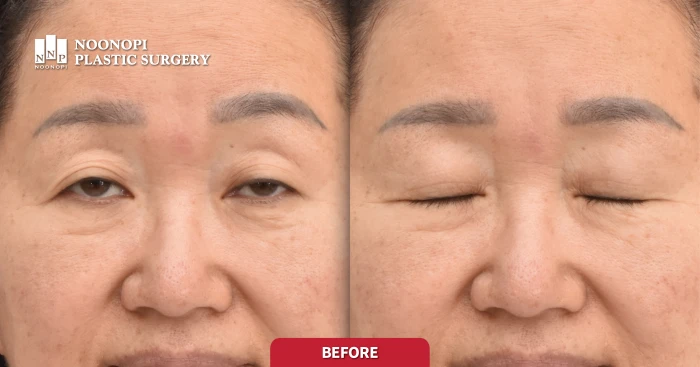
The Miracle in the OR: Beyond Expectations
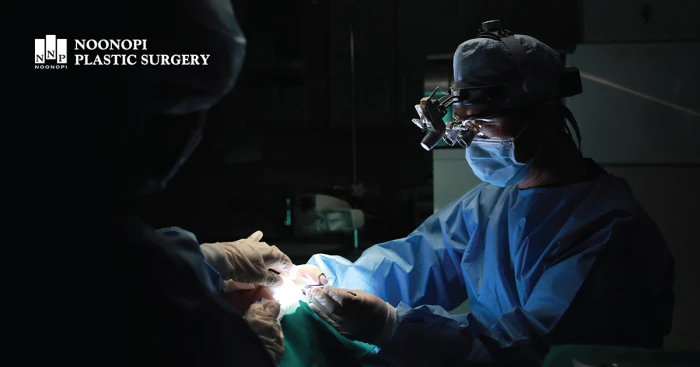
Tension always fills the operating room. Correcting asymmetric eyes with such a functional gap is a battle of 0.5mm precision.
The patient mentioned she had asymmetry in her youth, but it worsened with age. This suggested Involutional (Senile) Ptosis, where the levator muscle detaches from the tarsal plate and becomes loose.
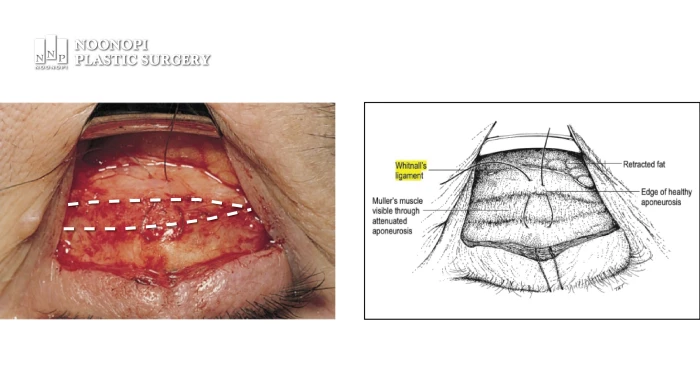
As we age, the connection between the levator muscle and the eyelid (white dotted line) loosens, causing sleepy eyes.(image reference)
I also visualized that the left levator muscle likely had significant fatty degeneration. Image training—visualizing the patient's internal anatomy—is crucial for surgical success.
However, a surprise awaited me during surgery. When I carefully dissected the left levator muscle, which I thought had little function, and released the adhesions restricting its movement, the muscle function was unexpectedly good!
"We can lift this higher!"
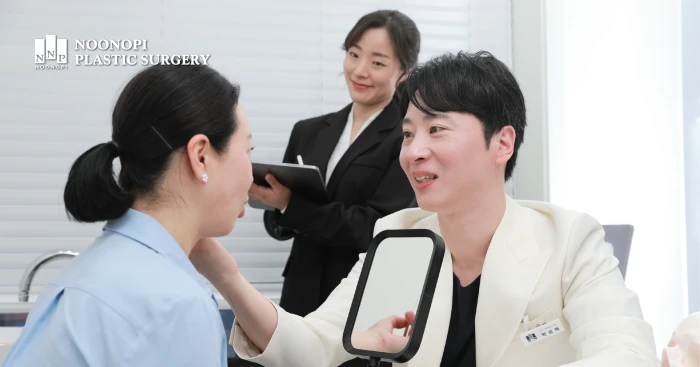
I consulted with the patient during the surgery, showing her a mirror, and adjusted our goal. We moved past the initial 60% target and aimed for 80% pupil exposure, completing a precise ptosis correction.
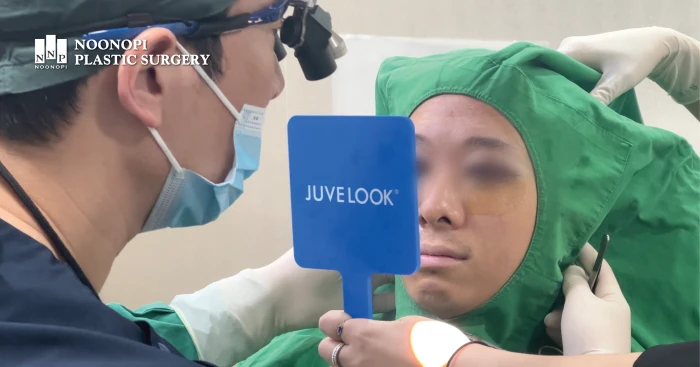
Eye surgery in Korea is famous for sitting the patient up during the procedure to check the shape and symmetry in real-time. When I shared this with an American surgeon colleague, he shook his head in disbelief:
"You guys are crazy. How do you do that?"
That "craziness" is actually our obsession with perfection.
"I Had a Nightmare My Eyelids Unraveled"
Since our initial video consultation, I had emphasized keeping her schedule open for a potential early revision. However, the result was so successful that no revision was needed. She enjoyed her time in Korea, visiting relatives and traveling.
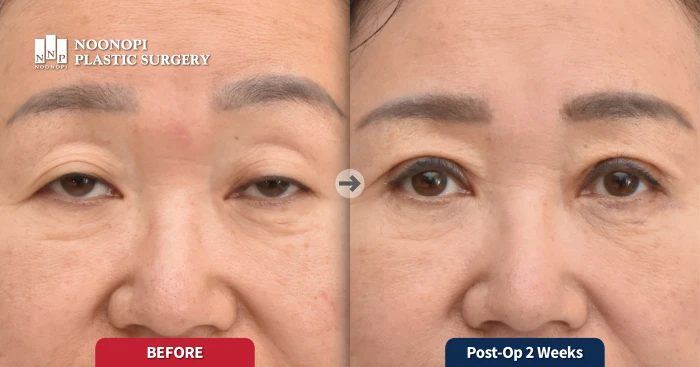
On her final check-up before leaving, she said something I still remember vividly:
"Dr. Park, I had a nightmare last night that my double eyelids disappeared! I guess I was anxious because the result is just too good to be true. (Laughs)"
It showed just how desperate she was to escape her droopy eyelids. She left for the US with a bright smile, leaving weeks of tension behind.
Conclusion: Why Experience Matters for Difficult Cases
If you are struggling with severe ptosis or asymmetric eyes, you will likely consult many clinics. Sweet words like "It will be perfectly beautiful" are easy to hear, but medicine never offers a 100% guarantee.
Instead of empty promises, look for a clinic that:
- Objectively measures your Levator Function and identifies your dominant eye.
- Has the experience to handle anatomical variations and unexpected variables during surgery.
For difficult cases, an honest diagnosis and a surgeon’s best effort create the patient's smile.
💡 Dr. Park's Closing Thought
"Everyone has facial asymmetry. But if it becomes a shadow on your heart, medical science can help erase it."
From a 1mm difference to congenital conditions, Noonopi Plastic Surgery matches your eye level with uncompromising delicacy.
🔗 Check Out Other Cases in This Series!
- [Case 1] [Fixing Slightly Uneven Eyes: Is Ptosis Surgery Worth It?]
- [Case 2] [Male eyelid asymmetry: Why I took a patient back to the OR on the same day]
💡 Ask Dr. Park
"Is my ptosis severe?" If you are worried about droopy eyelids or asymmetry, please send me a photo via WhatsApp or KakaoTalk. I will personally check it and give you an honest answer.